Porcelain Veneers vs Composite Bonding: Which Smile Makeover Is Right for You?
A smile makeover can mean something different to everyone. For one person, it may be about repairing a chipped tooth. For another, it may mean improving the shape, colour or proportions of several teeth. Modern cosmetic dentistry offers several ways to make these changes, but two of the most commonly considered options are porcelain veneers and composite bonding.
When researching porcelain veneers vs composite, it is easy to compare only the appearance or cost of each treatment. But there is much more to consider. Your dental health, the amount of correction required, your expectations, your bite and how long you want the results to last can all influence the decision.
Understanding veneers vs bonding can help you have a more informed conversation with your dentist. More importantly, it can help you choose a treatment that suits your smile rather than simply following what looks popular online.
What Are Porcelain Veneers and Composite Bonding?
Before comparing porcelain veneers vs composite, it helps to understand what each treatment actually does.
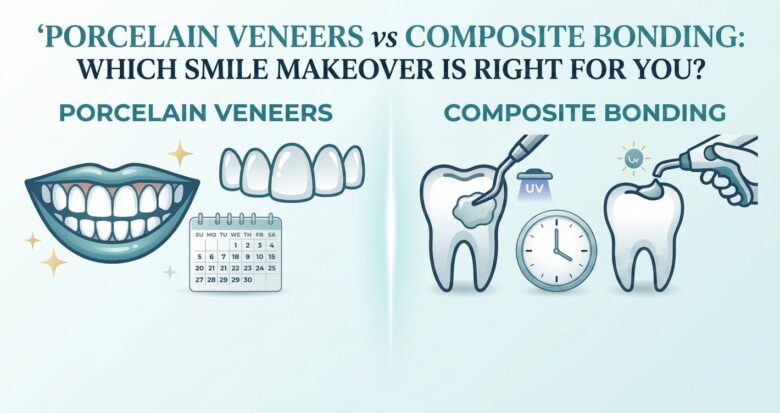
A porcelain veneer is a thin, customised shell designed to cover the visible front surface of a tooth. It can be used to improve the appearance of teeth affected by discolouration, minor chips, uneven shapes or certain spacing concerns. The veneer is carefully designed and then bonded to the tooth.
Composite bonding uses a tooth-coloured resin that is applied directly to the tooth. The dentist shapes the material to improve the tooth’s appearance before hardening and polishing it.
Both can be considered forms of cosmetic tooth covering, but they work quite differently. One uses a laboratory-fabricated restoration, while the other is sculpted directly on the tooth.
Understanding the different dental veneers types available is also important. Veneers can vary in material, design and preparation requirements, so the term does not necessarily describe one identical treatment for every patient.
When Is Composite Bonding a Better Choice?
One of the main advantages of composite bonding is that it can be useful for relatively small cosmetic corrections. A chipped edge, small gap or slightly uneven tooth shape may sometimes be improved with bonding.
When considering porcelain veneers vs composite, bonding can appeal to patients who want a conservative approach or only need changes to one or a few teeth. In suitable cases, little alteration to the natural tooth may be required, although this depends on the tooth and the desired result.
Another consideration in veneers vs bonding is that composite can often be repaired or modified relatively easily. This can be helpful when a small portion of the material chips or when a minor adjustment is needed.
However, composite resin can be more susceptible to staining and wear than porcelain. Coffee, tea, certain foods and habits such as biting hard objects can affect its appearance and longevity.
For someone considering cosmetic tooth covering, composite may therefore make sense when the desired change is relatively small and preserving as much natural tooth structure as possible is a priority.
When Could Porcelain Veneers Be More Suitable?
Porcelain veneers may be considered when a patient wants a more comprehensive aesthetic change and their teeth are suitable for the treatment.
They can alter the apparent colour, shape, length and proportions of teeth while maintaining a natural appearance when carefully planned. This makes them particularly relevant when several aesthetic concerns need to be addressed together.
In the discussion around porcelain veneers vs composite, porcelain is often considered when colour stability and durability are important priorities. Porcelain is generally more resistant to staining than composite resin, although veneers still require proper care and are not indestructible.
The choice also depends on the type of restoration being considered. Understanding dental veneers types can help patients realise that veneers are not simply identical shells placed over every tooth. Their design and preparation can vary according to individual needs.
A good cosmetic treatment should also consider the health of the tooth underneath. Decay, gum disease, bite problems and existing restorations should be assessed before deciding whether cosmetic tooth covering is appropriate.
Veneers vs Bonding: How Do the Results Look?
Both treatments can produce attractive results when used in the right situation. However, the way the final result is created is different. With composite bonding, the dentist directly shapes the material on the tooth. This provides considerable control during the procedure and can work particularly well for smaller, targeted changes.
With porcelain veneers, the restoration is designed before it is placed. This allows factors such as tooth colour, proportions, contours and symmetry to be planned carefully. So, when comparing porcelain veneers vs composite, it is not simply a question of which material looks better. The result depends on the treatment plan, the condition of the teeth and the skill and judgement involved in creating the smile.
This is where smile design becomes important. A good smile makeover should consider how the teeth relate to one another and to the rest of the face rather than making every tooth look artificially identical.
Which Option Lasts Longer?
Longevity is another major consideration in porcelain veneers vs composite.
Composite bonding generally has a shorter lifespan than porcelain veneers and may need polishing, repair or replacement over time. How long it lasts varies according to factors such as biting forces, oral hygiene, the location of the tooth and personal habits.
Porcelain veneers are generally more durable and resistant to staining, but they are still not permanent. They can chip, fracture or become damaged if exposed to excessive forces, particularly in people who grind or clench their teeth.
This is why discussing dental veneers’ types with your dentist is useful before treatment. The material, design and individual circumstances can all influence expected longevity.
Neither treatment should be viewed as a maintenance-free solution. Good oral hygiene, regular dental examinations and appropriate habits are important for protecting both the restoration and the natural teeth.
Does Composite Bonding Cost Less Than Veneers?
Cost naturally enters the veneers vs bonding discussion, but it should not be the only factor determining your decision. Composite bonding is generally less expensive per tooth because the material is applied directly and does not usually require the same laboratory fabrication process as porcelain. It may also be completed in fewer appointments in suitable cases.
Porcelain veneers usually require a greater investment because each restoration is customised and fabricated specifically for the patient. However, their durability and resistance to staining may make them worthwhile for someone looking for a longer-lasting aesthetic change.
When comparing porcelain veneers vs composite, look beyond the initial price. Consider how many teeth require treatment, how much correction is needed, how long you want the result to last and what maintenance may be required.
A lower initial cost does not necessarily make one treatment the better long-term choice, just as a higher investment does not automatically make another option more suitable.
How Much of the Natural Tooth Needs to Be Altered?
This is one of the most important questions to ask before choosing any form of cosmetic tooth covering.
Composite bonding can often be performed with minimal alteration to the natural tooth, particularly when only a small amount of reshaping is required. However, ‘minimal preparation’ does not necessarily mean no preparation at all.
Porcelain veneers may require some preparation to create the space needed for the restoration and achieve the planned appearance. The amount varies depending on the position and shape of the tooth and the treatment design.
This distinction is important when considering porcelain veneers vs composite. Patients should understand exactly what will happen to their natural teeth before agreeing to treatment. A responsible cosmetic approach should always balance aesthetic goals with the long-term health and structure of the natural tooth.
Can Veneers or Bonding Fix Crooked Teeth?
This is where expectations need to be realistic.
Neither bonding nor veneers should automatically be used to disguise significantly crooked or crowded teeth. If teeth are substantially rotated, crowded or incorrectly positioned, orthodontic treatment may be the more appropriate first step.
Minor irregularities may sometimes be improved cosmetically. However, using a restoration to compensate for a significant underlying alignment problem may not provide the most appropriate long-term solution.
This is an important part of the veneers vs bonding conversation because both treatments primarily change how teeth look; they do not move teeth into a new position. Similarly, different dental veneers types cannot replace orthodontic treatment when the underlying problem is significant tooth movement or bite correction.
In some cases, orthodontic treatment may be completed first, followed by cosmetic treatment if there are still aesthetic concerns that need attention.
What Role Does Smile Design Play?
A successful smile makeover is about more than making teeth look whiter or straighter. Good smile design considers tooth length, width, shape, proportions, symmetry, gum display and how the teeth relate to the patient’s facial features.
This becomes especially important when multiple teeth are being treated. A result that looks attractive on one tooth may not necessarily look natural when repeated across an entire smile. When discussing porcelain veneers vs composite, the material is only one part of the equation. Planning is equally important. Understanding dental veneers types and how each may affect the final result can help patients make a decision based on their individual facial features and dental needs rather than simply choosing a material.
What Should You Consider Before Choosing?
If you are still unsure about porcelain veneers vs composite, start by identifying what you actually want to change. Is there one chipped tooth that bothers you? Do you have small spaces between your teeth? Are several teeth discoloured or irregular in shape? Or are you looking for a broader smile transformation?
Your answers can help narrow down the possibilities, but a professional examination is still essential. Your dentist needs to assess enamel, cavities, gum health, existing restorations and bite forces before recommending cosmetic tooth covering.
It is also worth discussing habits such as teeth grinding, nail biting or chewing hard objects. These can affect the longevity of both bonding and veneers. A suitable treatment should not simply make your smile look better on the day. It should take the health, function and long-term maintenance of your teeth into account.
A Smile Makeover Should Still Look Like You
The best cosmetic dentistry does not make every smile look identical. It should work with your natural features and create a result that feels balanced and appropriate for you.
Whether you are comparing porcelain veneers vs composite, the starting point should be an honest discussion about what bothers you and what you hope to achieve. You may discover that bonding is enough, that porcelain veneers are more appropriate or that orthodontic treatment should come first. This is also why understanding dental veneers types before committing to treatment can be valuable. Different materials and approaches have different characteristics and your dentist should explain which one is appropriate for your situation.
At Teeth & Braces by Dr Atul Jajoo, cosmetic treatment is considered alongside the wider health, alignment and function of the smile. With over 20 years of experience, Dr Atul Jajoo holds a Master’s degree in Orthodontics and Dentofacial Orthopedics and brings extensive expertise in orthodontic and cosmetic dental care.
His approach combines orthodontic expertise with personalised cosmetic treatment planning, helping patients understand their options and make informed decisions about their smile.
If you are considering a smile makeover in Indore, a consultation is the best way to understand whether veneers or bonding is the right discussion for your smile. Dr Atul Jajoo can assess your teeth, discuss the relevant dental veneer types, explain the benefits and limitations of each approach and help you make a decision based on your individual needs.
Book a consultation to take the next step towards a smile that looks natural, feels healthy and feels like you.
FAQs:
Q1. Are porcelain veneers better than composite bonding?
Neither option is automatically better for everyone. Porcelain may offer greater durability and stain resistance, while composite can be more conservative for smaller corrections. The right choice depends on your teeth, aesthetic goals and treatment requirements. A professional assessment is important before choosing between the two.
Q2. How long do composite bonding and porcelain veneers last?
Composite bonding generally requires maintenance or replacement sooner than porcelain veneers. The lifespan of either treatment depends on oral hygiene, biting forces, habits and the condition of the teeth. Porcelain is generally more resistant to staining and everyday wear. Regular dental visits can help protect the results and identify problems early.
Q3. Can veneers fix crooked or crowded teeth?
Veneers can sometimes improve the appearance of minor irregularities, but they do not move teeth into a new position. Significant crowding or bite problems may require orthodontic treatment instead. Trying to disguise major alignment issues with restorations may not be the most appropriate approach. Your dentist or orthodontist can recommend the safest treatment sequence.
Q4. Is composite bonding reversible?
Composite bonding is often considered a conservative treatment because little or no natural tooth structure may need to be removed in suitable cases. However, whether it can be completely reversed depends on the preparation and treatment performed. The material can also require repair or replacement as it wears over time. Your dentist should explain the preparation and long-term considerations before treatment.